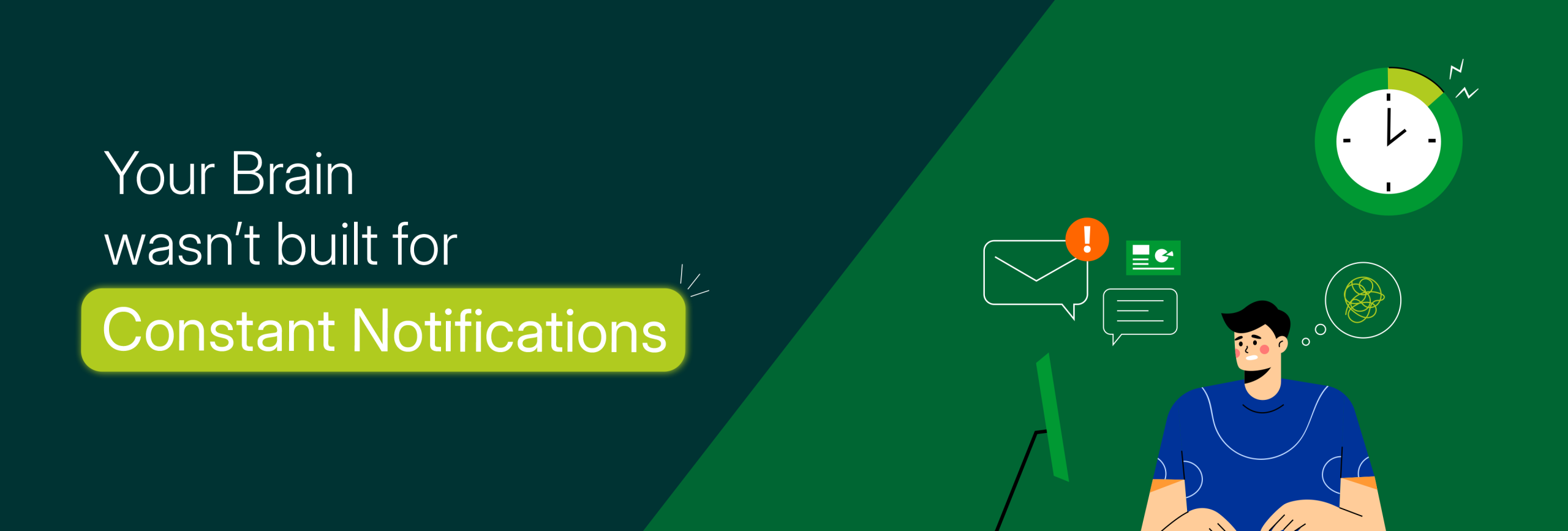
Your Brain Wasn’t Built for Constant Notifications
The hidden cognitive cost of being constantly reachable
At 9:07 a.m., Maya opens her laptop with one important task to finish before lunch: a presentation that needs her full attention. Three minutes later, a Teams notification appears: “Hey Maya, quick question…” She answers it. Her phone buzzes. Then Outlook flashes an email. She tells herself she’ll come back to it later. Another Teams notification appears. Then a calendar reminder.
By 11:30 a.m., Maya has been “working” for more than two hours. She has answered messages, checked emails, attended a meeting and glanced at her phone several times. She has been busy almost every minute. Yet her presentation is barely halfway done.
The problem is simple: being busy is not the same as being productive.
A notification is not work. It is an interruption.
We often treat notifications as small tasks: just a message, just an email, just a quick reply. But every notification asks our brain to make a decision: Should I look at this? Does it matter? Do I need to respond?
Even when we decide not to respond, our attention has already been pulled towards something else.
When you’re working on a complex task, your brain is holding information in working memory: what you are trying to solve, what you were just thinking about and what you planned to do next. An interruption forces you to shift away from that mental context and then rebuild it when you return.
That is why “just checking for a second” can cost much more than a second.
So why do we keep checking?
Because our brains are naturally drawn to novelty and unexpected rewards.
When your phone buzzes, you don’t know what is waiting for you. It could be an important message, an interesting update, a compliment, a funny video or absolutely nothing. That uncertainty makes checking surprisingly compelling.
Dopamine is often called the brain’s “pleasure chemical,” but its role is more nuanced. It is strongly involved in motivation, learning and reward prediction. When something unexpected might be rewarding, dopamine-related processes can reinforce the behaviour that helped us discover it.
This creates a simple loop:
Notification → Check → Possible reward → Check again.
Over time, the notification itself becomes a cue. We may reach for our phones before consciously deciding to. Sometimes, we even check when there is no notification at all.
The cost isn’t just lost time.
Frequent interruptions fragment attention. Instead of spending mental energy on the task that matters, we spend it switching between tasks, remembering what we left unfinished and deciding what deserves attention next.
That affects more than productivity.
Quality suffers because complex work needs sustained concentration.
Learning suffers because information needs attention to be processed, connected and remembered.
Critical thinking suffers because examining assumptions and alternatives requires mental space.
Creativity suffers when every quiet moment is immediately filled with another stimulus.
Relationships suffer when our attention is physically present but mentally elsewhere.
You can be in a meeting while checking messages. You can be having dinner while thinking about work. You can be listening to someone while wondering whether your phone has buzzed.
We can be physically present and mentally available somewhere else.
We have forgotten how valuable quiet can be.
Waiting for a lift? Check the phone.
Waiting for coffee? Check the phone.
Finished a task? Check the phone.
Feeling bored? Check the phone.
We have become very good at filling every quiet moment.
But quiet is not wasted time. The brain needs periods without constant external demands to process information, make connections and approach problems from different perspectives. Not every moment needs to be filled with input.
The goal isn’t to reject technology. Smartphones, email, Teams and other digital tools have transformed how we work and communicate.
The real question is: Are we using these tools intentionally, or have they started deciding where our attention goes?
Reachable doesn’t have to mean constantly interruptible.
We can create healthier boundaries around attention.
That might mean switching off non-essential notifications during focused work, checking email at defined intervals, protecting meeting time from competing platforms or using “Do Not Disturb” without treating silence as disengagement.
Organisations have a role too. Leaders can model the behaviour by not expecting an immediate response to every message. Teams can create norms that distinguish between something that is urgent and something that is simply new.
Because if everything demands attention immediately, nothing receives attention deeply.
Productivity isn’t always visible.
Sometimes productivity looks like someone spending forty uninterrupted minutes on one document.
It looks like an employee saying, “I’ll respond to this after I finish what I’m working on.”
It looks like a meeting where nobody checks their phone.
It looks like an hour blocked on a calendar and protected from interruptions.
It looks like silence.
Attention is the foundation for many of the capabilities organisations value most: critical thinking, learning, creativity, decision-making, listening and meaningful conversations.
We cannot continuously fragment attention and then expect deep thinking on demand.
Perhaps the real productivity challenge of the modern workplace isn’t getting people to do more. It is creating the cognitive space to do meaningful work well.
The goal isn’t to become less connected.
It is to become more intentional about what deserves our connection.
Because our brains were never designed to respond to everything.
They were designed to notice what matters.