Gen Z and the Future of Work: A Generational Shift in Workplace Culture
The Tale of Two Careers
Priya graduated from Delhi University in 2010 with a commerce degree and a dream job offer from a Big Four consulting firm. She was ecstatic. The long hours didn’t matter, the weekend emails were expected, and the idea of “switching off” seemed almost unprofessional. Her parents were proud. She had made it. Work-life balance was something you worried about after you’d “established yourself”, maybe in your late thirties.
Fast forward to 2024. Her younger cousin, Arjun, just turned down a similar offer. Despite the prestigious name and the handsome salary package, he chose a startup that offered him flexible hours, mental health days, and a four-day work week experiment. When Priya asked him why, he simply said, “Life is short. I want to live it, not just work through it.”
This conversation, happening in households across Mumbai, Bangalore, and Tier-2 cities alike, captures the seismic shift in workplace culture. Gen Z isn’t just entering the workforce, they’re rewriting its rules. And whether you’re an employer trying to attract talent or a millennial manager trying to understand your team, this transformation affects us all.
Understanding Gen Z: Who Are They?
Let’s start with the basics. Gen Z, broadly defined as those born between 1997 and 2012, are now flooding into Indian workplaces. The oldest are in their late twenties, climbing into mid-level positions, while the youngest are still finishing their degrees, internships saved in their LinkedIn profiles.
But here’s what makes them fundamentally different: they’re the first truly digital natives. While millennials remember a time before smartphones, Gen Z doesn’t. They grew up watching YouTube tutorials instead of waiting for TV shows, learning about social issues through Instagram reels, and witnessing their parents’ generation burn out in corporate jobs during economic crises.
In India specifically, this generation has come of age during unprecedented times. They saw demonetization disrupt traditional business models overnight. They witnessed the fastest digital adoption in the world, with their parents suddenly discovering UPI payments and video calls. And most significantly, they spent crucial formative years locked down during a pandemic, watching the entire concept of “going to work” become obsolete virtually overnight.
Unlike previous generations who questioned workplace norms after years of experience, Gen Z arrived with questions already formed. They didn’t need to burn out to realize the system was broken, they’d watched enough people around them do exactly that.
The Mental Health Crisis: Gen Z’s Defining Challenge
If there’s one issue that defines Gen Z’s workplace expectations, it’s mental health. And in India, this conversation is particularly revolutionary.
Remember when taking a sick leave meant you had to have a fever or a visible injury or your mother had to have malaria or your grandparents had many lives just like Mario? Gen Z is challenging that notion head-on. They’re calling in sick because of anxiety. They’re openly discussing therapy. They’re requesting mental health days. And most importantly, they’re not apologizing for it.
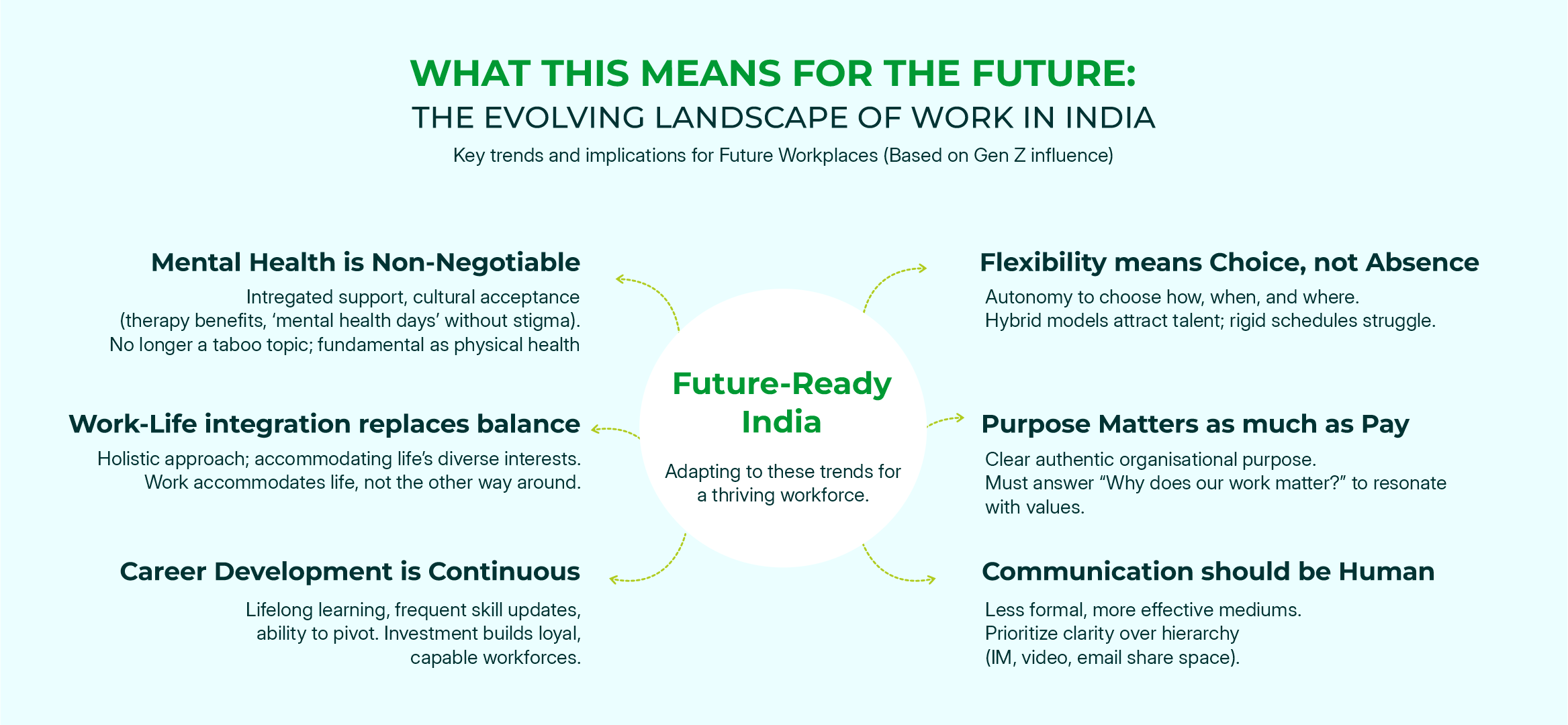
According to a Deloitte survey, mental health concerns ranked as the top issue for Gen Z globally, with Indian respondents showing even higher levels of stress and anxiety compared to their global counterparts (Deloitte, 2023). But here’s the thing, it’s not that Gen Z is inherently more anxious than previous generations. They’re just more willing to name it, discuss it, and demand that their employers take it seriously.
This shift makes some older managers uncomfortable. “We all had stress, and we managed,” they say. But that’s precisely the point. Gen Z watched millennials “manage” their stress right into burnout, broken relationships, and health problems by their mid-thirties. They’re choosing a different path.

Redefining Success: Career Growth and Work-Life Balance
Ask a baby boomer or even a millennial what career success looks like, and they’ll probably paint a picture: promotions every few years, a corner office, maybe becoming a VP by forty. It’s a linear trajectory, upward and visible.
Ask Arjun, our startup employee from earlier, and you’ll get a completely different answer. Success, for him, means working on projects he cares about, having time to learn new skills, traveling twice a year, maintaining his friendships, and yes, making enough money to live comfortably, but not at the expense of everything else.
This isn’t laziness or lack of ambition. It’s a fundamental redefinition of what ambition means. McKinsey’s research on generational shifts in the workplace reveals that Gen Z values purpose and personal development over traditional markers of success (McKinsey & Company). In the Indian context, this is particularly striking. We’re talking about a generation that’s willing to turn down the IIT-IIM-MNC pipeline if it doesn’t align with their values.
The work-life balance conversation has evolved too. Previous generations fought for work-life balance as a distant goal, something you achieved after putting in your dues. Gen Z views it as a baseline requirement, not a reward. They’re not interested in sacrificing their twenties for a promise of balance in their forties.
The Flexibility Paradox: Gen Z and Remote Work
The pandemic was Gen Z’s workplace baptism by fire. Many entered the workforce during lockdowns, experiencing remote work as their normal, not as a crisis measure. And now, they’re refusing to let it go without a fight.
But here’s where it gets interesting: Gen Z’s relationship with remote work is more nuanced than the stereotype suggests. They don’t necessarily want to work from home all the time. What they want is choice.
This is the flexibility paradox. While Gen Z fought hard for remote work during the Great Return-to-Office debate, many also report feeling isolated and disconnected when working entirely remotely. They crave the social aspects of office life, the chai breaks, the spontaneous brainstorming sessions, the mentorship opportunities. They just don’t want these tied to a mandatory 9-to-6 schedule in a specific location.
Indian companies are struggling to navigate this. Some have embraced hybrid models, while others have issued strict return-to-office mandates, only to watch their Gen Z talent walk out the door. The winners in the talent war are those who’ve realized that flexibility isn’t binary, it’s about creating options and trusting employees to choose what works best for their productivity and wellbeing.
Communication Revolution: Beyond the Email
Gen Z has revolutionized workplace communication in ways that sometimes baffle older colleagues. They prefer quick, informal messages over formal emails. They’d rather jump on a spontaneous five-minute video call than exchange twenty emails. They use emojis in professional contexts without a second thought. And they absolutely despise unnecessary meetings.
This isn’t about being casual or unprofessional. It’s about efficiency. Having grown up with instant messaging, Gen Z instinctively understands which medium suits which message. Complex feedback? Let’s have a video call. Quick question? Drop a message. Need something documented? Then yes, send an email.
In Indian workplaces, where hierarchical communication has traditionally been the norm, this shift is particularly noticeable. Gen Z employees are more likely to message the CEO directly with an idea than to go through three layers of management. They’re less concerned with formal titles in communication and more focused on getting things done.
This casual communication style has sparked debates about professionalism. But perhaps we’re asking the wrong question. Instead of “Is this too casual?” maybe we should ask “Is this effective?” Because in a world where collaboration happens across time zones and projects move at startup speed, the old formalities can become obstacles rather than marks of respect.

Purpose Over Pay checks: The Values-Driven Generation
Research from Harvard Business Review indicates that younger workers increasingly prioritize purpose and values alignment in their career choices, even being willing to accept lower compensation for meaningful work (Harvard Business Review, 2021). In India, where the startup ecosystem has exploded with companies claiming to solve every problem from education to agriculture, Gen Z is reading beyond the mission statements.
This values-driven approach extends to workplace culture too. Gen Z won’t tolerate toxic environments, even if the pay is exceptional. They’re more likely to report harassment, call out discrimination, and demand accountability. And thanks to social media, they have platforms to do so loudly.
The Skills Gap: Education Versus Reality
Gen Z graduates are entering the workforce with degrees that were designed for a world that no longer exists, especially with the advancement of AI. They’ve spent years memorizing theories and taking exams but often lack practical skills that employers desperately need. And they know it. Unlike previous generations who might have blamed themselves for this gap, Gen Z is openly frustrated with an education system that failed to prepare them.
This awareness is driving interesting changes. Gen Z isn’t waiting for formal education to catch up. They’re taking online courses, building portfolios through freelance work, learning from YouTube tutorials, and teaching themselves skills that weren’t in any syllabus. A computer science graduate might have learned more from a three-month bootcamp than from four years of college.
For employers, this creates both challenges and opportunities. The challenge: you can’t rely on degrees as proof of capability. The opportunity: Gen Z employees are often self-starters who know how to learn quickly.
Companies that are winning with Gen Z talent are those that offer continuous learning opportunities. Not just annual training sessions, but ongoing access to courses, mentorship programs, and opportunities to work on diverse projects. Gen Z doesn’t want to do the same job for five years; they want to constantly evolve.
The Employer Response: Adapting to Gen Z Expectations
So how are Indian companies responding to these transition? The answer is: it depends.
Some organizations, particularly startups and tech companies, are embracing these changes wholeheartedly. They’re redesigning their entire people strategies around Gen Z expectations, offering flexible work arrangements, prioritizing mental health, creating purpose-driven cultures, and rethinking traditional hierarchies.
Others are resisting, convinced that Gen Z will eventually “grow up” and conform to traditional workplace norms. They’re issuing return-to-office mandates, maintaining rigid hierarchies, and dismissing conversations about mental health as millennial nonsense taken to the extreme. These companies are finding it increasingly difficult to attract and retain young talent.
And then there’s the middle ground, organizations that want to adapt but are struggling with how. They’re piloting hybrid work models while worrying about productivity. They’re adding mental health resources while wondering if they’re enabling weakness. They’re trying to inject purpose into profit-driven missions.
The most successful adaptations share common threads. They involve Gen Z employees in designing solutions rather than imposing top-down changes. They treat flexibility as a system, not a perk. They measure outcomes rather than hours. And perhaps most importantly, they’re willing to experiment and learn.
Conclusion: Embracing the Evolution
What often gets lost in conversations about Gen Z and the workplace is this: it’s not about one generation being right and another being wrong. It’s about accepting that the world of work is changing and Gen Z happens to be the generation forcing us to confront that change.
The old model, sacrifice your youth, climb the ladder, earn flexibility later, was never truly sustainable. It simply took a generation that witnessed its consequences without ever reaping its promised rewards to call it out.
Back to Priya and Arjun. After their conversation, Priya began questioning her own definition of success. In chasing stability and status, she realized she’d sidelined her health, relationships, and parts of herself she was now trying to reclaim. Today, she’s working with her HR team to pilot a flexible work program, not because she’s adopted “Gen Z thinking,” but because she’s starting to see that this generation might be onto something.
She’s now working with her company’s HR team to pilot a flexible work program. Not because she’s converted to “Gen Z thinking,” but because she’s realized that maybe, just maybe, this generation isn’t naïve, they’re onto something.
The future of work in India isn’t about Gen Z winning and older generations losing. It’s about building workplaces that work for everyone, where careers don’t come at the cost of wellbeing, productivity isn’t measured by hours logged, and success means more than a job title.
This shift won’t be comfortable. It asks us to unlearn, to experiment, and to let go of assumptions we’ve held for decades. But the organizations that embrace this evolution won’t just attract Gen Z—they’ll create environments where people across generations can do meaningful work and still live full lives.
And really, isn’t that what we were all aiming for? Gen Z is just bold enough to say it out loud.
References
- Deloitte. (2023). The Deloitte Global 2023 Gen Z and Millennial Survey. Deloitte Insights. https://www.deloitte.com/global/en/issues/work/content/genzmillennialsurvey.html
Harvard Business Review. (2021). What younger workers need from their employers. Harvard Business Review. https://hbr.org/2020/06/what-your-youngest-employees-need-most-right-now
McKinsey & Company. (2022). The Gen Z equation https://www.mckinsey.com/quarterly/the-five-fifty/five-fifty-the-gen-z-equation