Who Do You Ask First? How AI Is Quietly Redrawing the Map of Team Behaviour (By Dhruv Marathe)
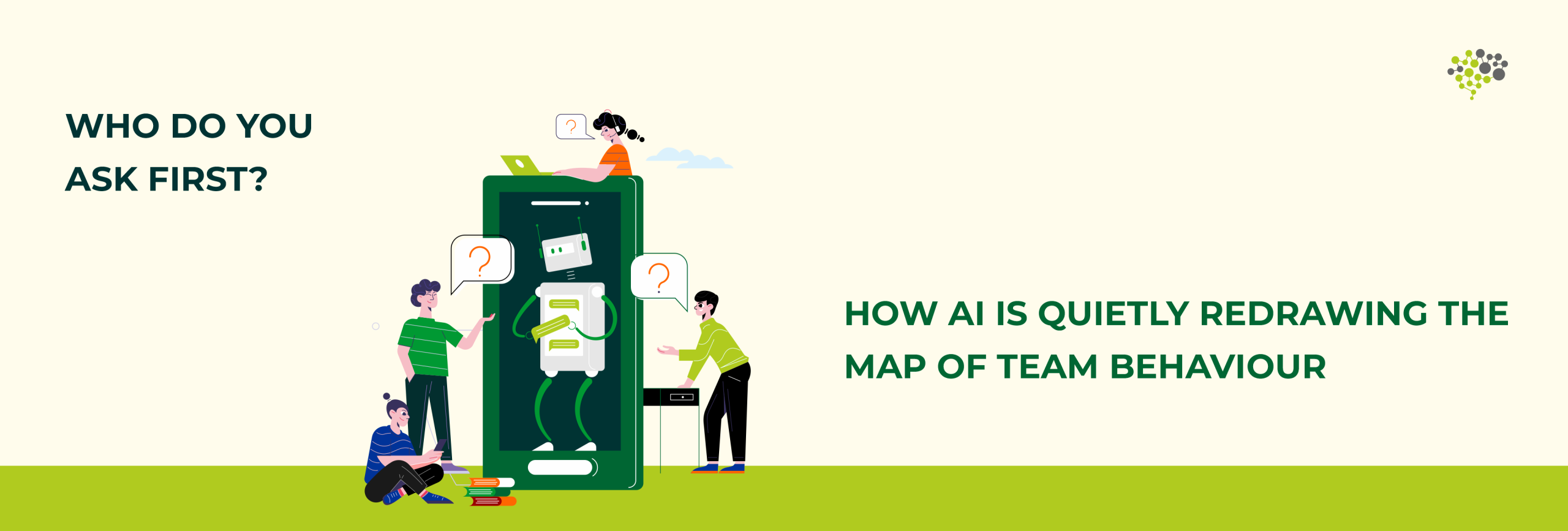
Think about the last time you got stuck at work. Who did you ask?
It’s 4:40 on a Friday, and Priya is stuck. A client proposal is due Monday, and one pricing assumption won’t hold up. Two desks away, Arjun is stuck on the same thing.
Priya messages Kavita, who built last year’s model. “Call me, it’s easier,” Kavita writes back. Ten minutes in, Priya learns the assumption was revisited after a difficult client negotiation that never made it into any document. Kavita learns what Priya is working on.
Arjun opens a chat window. Within seconds, he has a clean, confident answer and pastes it in.
Both finish before six, and honestly, Arjun’s answer reads better. But the tool couldn’t tell him about a negotiation nobody wrote down, and only one of those moments changed what the team knows about itself. Now imagine that choice made for every small question, every week, across a whole team. Researchers call what builds up “relationslipping” (Niederhoffer et al., 2026). The question behind it is simple: when AI becomes the first one we ask, what happens to the people we stopped asking?
One thing up front. This isn’t an argument that AI is the problem. It’s an early trend that could become a real problem, but only through what people do. AI is the latest in a long line of disruptors, from television to the internet to the smartphone, that have pushed us to rethink our role in the system.
What do teams actually run on?
Ask Priya who to go to on her team and she can answer without thinking: who knows why last year’s client left, who understands how approvals really work, who to approach when a stakeholder is difficult. Researchers call this a transactive memory system, a shared sense of who knows what that lets people lean on each other instead of carrying everything alone (Niederhoffer et al., 2026). It gets drawn in small moments, a quick question, a long chat, a “you should ask Kavita about that”, and without those conversations the map has less to go on.
Expertise on that map is shifting, not disappearing. In a field experiment with consultants at Boston Consulting Group, those who started below the average gained far more from AI on suitable tasks than those who started above it (Dell’Acqua et al., 2026). Some organisations are already merging adjacent roles that now overlap. But a narrower gap isn’t no gap. Give Rohan, happiest in spreadsheets, and Ananya, who would rather spend a week with interview transcripts, the same tool and brief, and they’ll ask different things and catch different mistakes. What sets colleagues apart may be less technical know-how and more context and judgement, which a team only learns by talking.
How is this different from search?
Search has played a similar role for years. Most teams had someone brilliant at finding things, but search never replaced asking people. It handed back sources you still had to weigh, often with a colleague. AI is different in three ways. It hands you one fluent answer, shaped by how you framed the question and by what it was trained on, and it can’t know what was never written down. On a task outside its strengths, consultants using it were noticeably less likely to get the right answer (Dell’Acqua et al., 2026). A colleague, meanwhile, brings experience and a reaction: if Arjun’s draft had gone to Kavita, she’d have pushed back on his framing and warned him which stakeholder would hate that slide. And good results from AI ask more of you than a search did, because you need to know what context to give and when not to trust the answer.
That doesn’t make AI bad for teams. People have long been frustrated by colleagues who ask before trying anything, and AI takes that cost away, a real gain. The risk is what goes with it. If every question goes to a chat window first, fewer exchanges mean fewer chances to build trust, so distance can grow without anyone choosing it. The difference isn’t about finding information. It’s about which exchanges quietly stop along with the ones we were glad to lose.
What is relationslipping?
Relationslipping is the term researchers use for working relationships that gradually weaken as team members substitute AI for one another (Niederhoffer et al., 2026). Like a boat slipping its mooring, nothing dramatic happens on any single day. It describes a behaviour, not a verdict on AI: a team can use AI heavily and keep its relationships as long as people carry on talking.
Nor is the worry new: an earlier study of home internet use found social costs that faded as people learned to use it to strengthen their relationships (Niederhoffer et al., 2026). The question at this inflection point is the same: what is the human part now? A good candidate is what AI can’t hold: context, judgement, trust and knowing who knows what. Teams that protect the conversations carrying those things are redefining the role on purpose. Teams that leave it to habit redefine it by default.
What does the research say?
Researchers have started looking for the pattern Priya and Arjun are acting out. A survey of US desk workers on project teams found that the more people used AI, the more they felt their teammates had specialised knowledge. But people who often went to AI instead of a teammate rated their team’s trust and coordination lower, by roughly a fifth each (Niederhoffer et al., 2026). What didn’t rise was how well people knew who knows what, so a team can look more expert on paper while becoming harder to read from the inside.
Work data agrees. A preprint following tens of thousands of employees given Copilot found that, among heavy users, work in documents and spreadsheets grew much faster than activity in communication tools, while small-group emails and the number of people contacted dipped (Yu et al., 2026). And in Chinese organisations, the more a colleague was seen as collaborating with AI, the less willing coworkers were to help them, largely because observers read it as laziness (Wu & Jiao, 2026).
These are associations. A single survey can’t say which way the link runs, the email dips were modest, and the helping study measures perceived AI use, not actual use. Teams with less trust may even reach for AI sooner, but the studies share a direction worth watching.
Why might it happen?
In the same survey, going to AI rather than a teammate was about equally common across age, seniority, industry and team size, yet people on teams with low psychological safety were far more likely to do it (Niederhoffer et al., 2026).
Picture Neha, three weeks into a new job, with a question she suspects is basic. Asking a person costs her something: someone’s time, a small admission of what she doesn’t know, and some courage if the team doesn’t feel safe. The chat window is quick and never judges. Yet using AI can cost something too, because some colleagues read it as laziness (Wu & Jiao, 2026), so she may use it quietly. And where the speed of an answer is visible and the ten minutes spent helping a colleague aren’t, skipping the conversation can be a sensible move. Nobody has to mean any harm, and the team can still end up worse off.
And what about India?
Nothing we found tests relationslipping directly in Indian teams, but two surveys set the scene. Atlassian’s State of Teams 2026 survey found that 98% of Indian knowledge workers use AI at work, and more of them have built it into how they work than the global average. Yet 86% said that when everyone is in “execution mode”, there’s no time or capacity left to coordinate (Atlassian, 2026). The survey comes from a team-software company, so it’s a snapshot, not proof.
In a survey of employees at Indian IT firms, trust in AI shaped attitudes towards using it, and what colleagues, peers and supervisors did and expected shaped both attitude and intention, so AI habits in these teams spread socially (Kumar et al., 2026). A lead who answers every query with a chat window teaches the team how work gets done, while one who says “ask me first, then check it with AI” teaches something different. The study didn’t test that, and its snowball sampling makes it only indicative.
What does this mean for L&D?
Back to Neha. Much of what people learn at work comes from other people: asking, watching, being corrected, overhearing. By her second week she has put more questions to the chat window than to her team. The answers are good, but she isn’t getting the picture: who owns what, who has seen this before, who will tell her honestly when she’s wrong. If the thinning is real, learning will probably feel it early. Training transfer also leans on supervisor and peer support (Hughes et al., 2020), and when questions move into a private chat window, managers and L&D see fewer signals of what’s unclear.
Build the map on purpose in onboarding, with introductions by expertise and guides that name people, not only documents. Teach when to ask AI, when to ask a person, and when to do both. Keep peers and managers involved after a programme.
Conclusion
Go back to the question we started with. The last time you got stuck at work, who did you ask?
Teams don’t hold together because everyone is fast. They hold together because people know each other well enough to ask: who knows this, who can be trusted with that, who’ll say so when I’m wrong. That map is built one conversation at a time, like the ten minutes between Priya and Kavita that no dashboard will ever count.
The studies show associations, not proof that AI weakens teams, and the pattern isn’t inevitable. None of this is a case against AI. It’s the latest disruptor to ask people to work out what they want from each other, and any harm would come from how we behave, not from the tool. If your team uses AI heavily and still talks, that’s worth sharing.
A small place to start: think of the last three questions you put to an AI tool. Which of them would have been better as a conversation?
References
Atlassian. (2026, April 28). India’s AI boom exposes a team coordination crunch, Atlassian report finds [Press release on the State of Teams 2026 report]. https://www.analyticsinsight.net/press-release/indias-ai-boom-exposes-a-team-coordination-crunch-atlassian-report-finds
Dell’Acqua, F., McFowland, E., III, Mollick, E. R., Lifshitz-Assaf, H., Kellogg, K., Rajendran, S., Krayer, L., Candelon, F., & Lakhani, K. R. (2026). Navigating the jagged technological frontier: Field experimental evidence of the effects of artificial intelligence on knowledge worker productivity and quality. Organization Science. https://doi.org/10.1287/orsc.2025.21838
Hughes, A. M., Zajac, S., Woods, A. L., & Salas, E. (2020). The role of work environment in training sustainment: A meta-analysis. Human Factors, 62(1), 166–183. https://doi.org/10.1177/0018720819845988
Kumar, S., Moslehpour, M., Walawalkar, A. M., & Kumar, V. (2026). Remote collaboration of employees reframed with the lens of AI efficiency, trust and ethical visions. Journal of Information, Communication and Ethics in Society. https://doi.org/10.1108/JICES-10-2025-0287
Niederhoffer, K., Rapuano, K., Liebscher, A., Robichaux, A., & Hancock, J. T. (2026, October 15). Team dynamics weaken when employees turn to AI instead of colleagues. Harvard Business Review. https://hbr.org/2026/10/team-dynamics-weaken-when-employees-turn-to-ai-instead-of-colleagues
Wu, Y., & Jiao, Y. (2026). How employee–AI collaboration influences coworkers’ helping behaviour: An attribution theory perspective. Behavioral Sciences, 16(6), 985. https://doi.org/10.3390/bs16060985
Yu, Y., Chen, Y., Hu, R., Suri, S., & Counts, S. (2026). Adoption of generative AI in the workplace: Increasing and shifting the balance of productivity and communication activity [Preprint]. arXiv:2608.15550. https://arxiv.org/abs/2608.15550